Bigeminy on the ECG
Bigeminy is a repeating pattern in which every second beat is a premature ectopic, so that each normal sinus beat is followed by an ectopic beat in an unbroken alternating sequence.
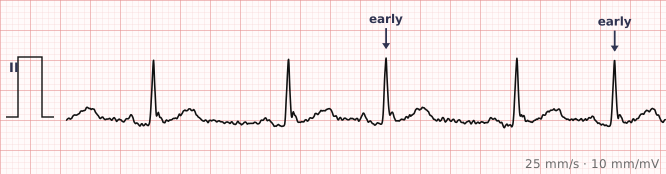
ECG criteria
| Feature | What you see in Bigeminy |
|---|---|
| Pattern | Sinus, ectopic, sinus, ectopic — a 1:1 alternation sustained over the strip. |
| Ectopic type | Ventricular bigeminy is far more common: the ectopic is wide with no preceding P. Atrial bigeminy has a narrow ectopic with an abnormal P. |
| Rate | Note that the pulse rate may be half the ECG rate, since ectopics often fail to generate a palpable pulse. |
| Rhythm | Regularly irregular — the irregularity itself follows a strict repeating pattern. |
| Coupling interval | Constant. The distance from each sinus beat to its ectopic is the same throughout. |
| Morphology | All ectopics look identical in unifocal bigeminy, which is the usual case. |
How to spot it
- Notice that the irregularity is patterned rather than random. That alone separates it from atrial fibrillation.
- Confirm the alternation runs one-for-one across the strip — a single ectopic every other beat, sustained.
- Classify the ectopic. Wide with no P wave is ventricular; narrow with an abnormal P is atrial.
- Check the coupling interval is fixed. Variable coupling suggests parasystole rather than true bigeminy.
- Compare the ECG rate with the palpable pulse. A pulse deficit is expected, and it explains why a patient in bigeminy may feel their heart is going slowly.
What it gets confused with
| Looks like | How to tell them apart |
|---|---|
| Atrial fibrillation | Randomly irregular with no P waves. Bigeminy is patterned and reproducible. |
| Trigeminy | Every third beat is ectopic rather than every second. |
| 2:1 AV block | Alternate P waves fail to conduct, so beats are dropped. In bigeminy an extra beat is added, not removed. |
| Ventricular parasystole | Ectopics with a variable coupling interval, from an independent focus firing at its own rate. |
| Electrical alternans | Beat-to-beat variation in QRS amplitude with normal timing, not an extra ectopic beat. |
Traps
- The pulse can be half the true heart rate, because ectopic beats come too early to fill the ventricle and may generate no palpable pulse. A patient in bigeminy at 80 on the ECG can have a pulse of 40.
- Bigeminy is frequently reported as an irregular rhythm and mistaken for atrial fibrillation. The pattern is the clue: bigeminy repeats, AF does not.
- Always say which kind. "Bigeminy" alone does not tell the reader whether the ectopics are ventricular or atrial, and those differ in significance.
- A fixed coupling interval matters. Variable coupling points to parasystole, which behaves differently.
Why it happens
An ectopic focus and the sinus node settle into a stable relationship, with the ectopic firing once for each sinus beat. In ventricular bigeminy, the compensatory pause after each ectopic lengthens the following cycle, which in turn favours the ectopic firing again at the same coupling interval — a self-sustaining loop that keeps the pattern regular.
Why it matters
Bigeminy is usually benign, particularly in a structurally normal heart, but it doubles the ectopic burden compared with occasional beats and can be symptomatic. Its main practical importance is the pulse deficit it produces, and the ease with which it is mistaken for atrial fibrillation.
Questions
Why is the pulse slower than the ECG rate in bigeminy?
The ectopic beat arrives early, before the ventricle has filled properly, so it ejects little or no blood and may produce no palpable pulse. Only the sinus beats are felt, halving the apparent rate.
Is bigeminy dangerous?
Usually not, particularly with a structurally normal heart. It is worth investigating when it is symptomatic, sustained over long periods, or occurs alongside structural heart disease.
What is the difference between bigeminy and trigeminy?
The ratio. In bigeminy every second beat is ectopic; in trigeminy every third is; in quadrigeminy every fourth.
Reading about bigeminy is not the same as calling it on a tracing you have never seen.
Practise on real cases in ECG Pro