Trigeminy on the ECG
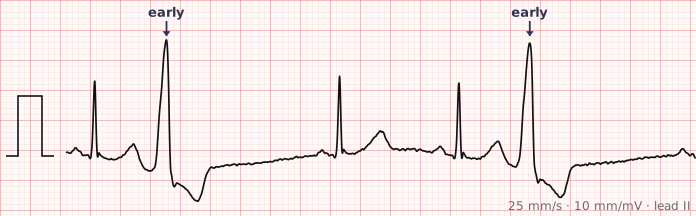
Trigeminy is a repeating pattern in which every third beat is a premature ectopic, so that two normal sinus beats are followed by one ectopic beat in a sustained sequence.
ECG criteria
| Feature | What you see in Trigeminy |
|---|---|
| Pattern | Sinus, sinus, ectopic, repeating across the strip. |
| Ectopic type | Ventricular is more common — wide, no preceding P. Atrial trigeminy has a narrow ectopic with an abnormal P wave. |
| Rate | Roughly two-thirds of ECG complexes generate a pulse, so a modest pulse deficit is expected. |
| Rhythm | Regularly irregular, with a strict repeating three-beat cycle. |
| Coupling interval | Constant from each sinus beat to its ectopic. |
| Morphology | Ectopics identical to one another in the usual unifocal form. |
How to spot it
- Look for a pattern rather than random irregularity — count the beats between ectopics.
- Confirm the ratio is two normal beats to one ectopic, sustained over several cycles.
- Classify the ectopic as ventricular (wide, no P) or atrial (narrow, abnormal P).
- Check the coupling interval is fixed.
- Describe it fully: "ventricular trigeminy" says more than "trigeminy", and much more than "irregular rhythm".
What it gets confused with
| Looks like | How to tell them apart |
|---|---|
| Bigeminy | Every second beat is ectopic rather than every third. |
| Quadrigeminy | Every fourth beat is ectopic. |
| Atrial fibrillation | Randomly irregular, no P waves, no repeating pattern. |
| Second-degree AV block | A beat is dropped rather than added, and P waves outnumber QRS complexes. |
| Occasional PVCs | Ectopics present but not in a sustained repeating ratio. |
Traps
- Count carefully. Bigeminy, trigeminy and quadrigeminy are distinguished only by the ratio, and a hurried glance mislabels them routinely.
- The ratio should be sustained. A single group of two-then-ectopic is just an isolated PVC, not trigeminy.
- As with bigeminy, ectopic beats may generate no pulse, so the palpable rate will be lower than the ECG rate.
- Trigeminy is usually benign but is worth quantifying, since a persistent high ectopic burden can affect ventricular function over time.
Why it happens
The same self-sustaining relationship that produces bigeminy, at a different ratio: an ectopic focus fires once for every two sinus beats, with the compensatory pause after each ectopic helping to set up the timing of the next. The stability of the coupling interval is what makes the pattern reproducible rather than random.
Why it matters
Trigeminy carries a lower ectopic burden than bigeminy and is generally benign in a structurally normal heart. Like all patterned ectopy, its main importance is being recognised as patterned — which rules out atrial fibrillation — and being quantified, since total ectopic burden is what determines whether it needs attention.
Questions
What is trigeminy on an ECG?
A repeating rhythm in which every third beat is a premature ectopic: two sinus beats then an ectopic, sustained over the tracing.
Is trigeminy worse than bigeminy?
Generally less significant, because the ectopic burden is lower — one ectopic in three beats rather than one in two. Both are usually benign in a structurally normal heart.
Can trigeminy be atrial?
Yes. The ectopic can be atrial, giving a narrow QRS with an abnormal P wave, or ventricular, giving a wide QRS with no preceding P. Ventricular trigeminy is the more common.
Reading about trigeminy is not the same as calling it on a tracing you have never seen.
Practise on real cases in ECG Pro