Alternans on the ECG
Electrical alternans is beat-to-beat alternation in the amplitude or axis of the ECG complexes at a constant heart rate, most characteristically involving the QRS complex and classically associated with a large pericardial effusion.
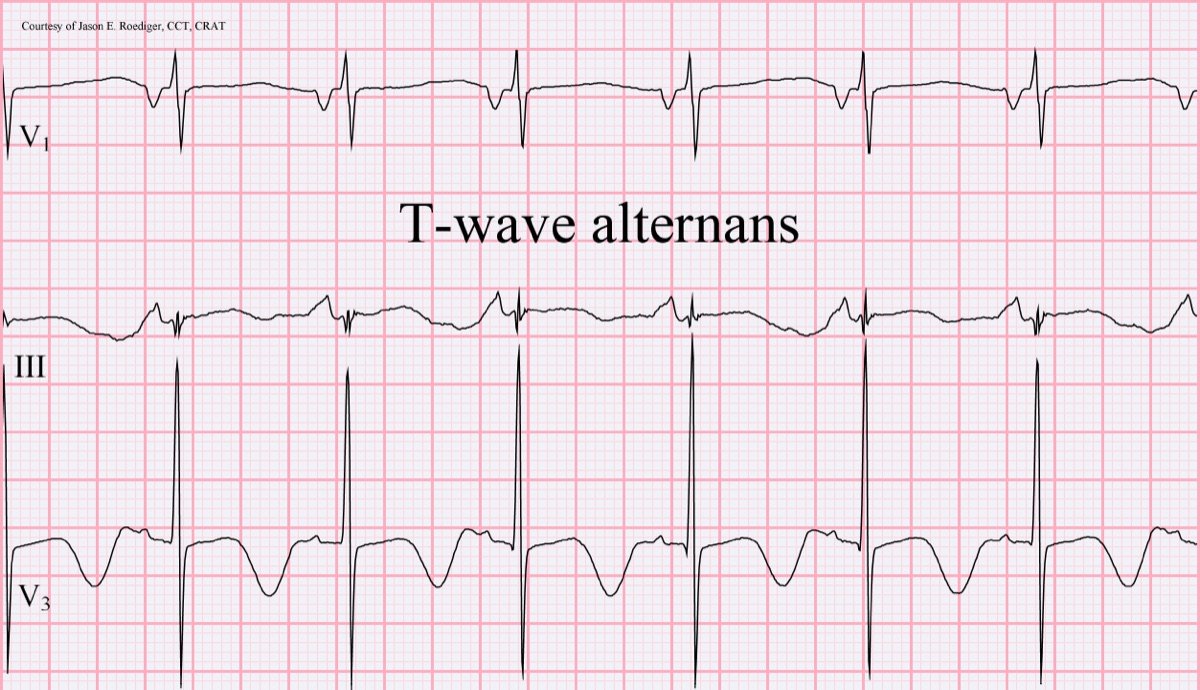
ECG criteria
| Feature | What you see in Alternans |
|---|---|
| Pattern | Alternating amplitude from beat to beat, in a regular ABAB sequence. |
| Rate | Constant. The timing does not vary — only the amplitude. This separates it from ectopy. |
| QRS alternans | The classic form. Strongly associated with large pericardial effusion and tamponade. |
| Voltage | Often accompanied by low voltage overall when caused by effusion. |
| T wave alternans | Alternation in T wave amplitude or polarity — a marker of electrical instability and arrhythmic risk. |
| Rhythm | Usually sinus tachycardia when caused by tamponade. |
How to spot it
- Notice that alternate complexes differ in height while the rhythm stays regular.
- Confirm the R-R intervals are constant. Alternating amplitude with constant timing is alternans; an extra early beat is bigeminy.
- Check the overall voltage. Low voltage plus QRS alternans plus sinus tachycardia is the classic tamponade triad.
- Look at whether the alternation involves the QRS, the T wave, or both.
- Treat QRS alternans as a prompt for urgent echocardiography rather than as an ECG curiosity.
What it gets confused with
| Looks like | How to tell them apart |
|---|---|
| Bigeminy | An extra ectopic beat alternating with sinus beats, so the timing is irregular. Alternans has regular timing. |
| Respiratory variation | Amplitude varies gradually with the breathing cycle rather than strictly alternating beat to beat. |
| Artefact or lead movement | Irregular, affecting some leads and not others, without a consistent alternating pattern. |
| Pericardial effusion | Not an alternative but the classic cause — low voltage with QRS alternans and tachycardia. |
| T wave alternans | Alternation confined to the T wave; a marker of repolarisation instability rather than effusion. |
Traps
- Distinguishing alternans from bigeminy is the key skill. Alternans varies amplitude at constant timing; bigeminy inserts an early ectopic beat and the timing is irregular. Measure the R-R intervals.
- QRS alternans with low voltage and sinus tachycardia should trigger urgent assessment for cardiac tamponade — this is one of the few ECG findings that is close to specific.
- Alternans can be subtle and is easier to see in a long rhythm strip than in short lead segments.
- T wave alternans visible on a standard ECG is uncommon; microvolt T wave alternans requires specialised analysis and is used for arrhythmic risk stratification.
- Alternans can also occur in severe heart failure and during tachyarrhythmias, so it is not exclusively a tamponade sign.
Why it happens
In pericardial tamponade the heart swings back and forth within a fluid-filled pericardial sac, so its position relative to the electrodes alternates with each beat. Because the recorded amplitude depends on the orientation of the cardiac vector relative to each lead, the swinging motion produces regularly alternating complex heights. T wave alternans has a different basis: alternating action potential duration between beats, reflecting instability of repolarisation.
Why it matters
QRS alternans is one of the more specific findings on the ECG. Combined with low voltage and sinus tachycardia it points strongly to a large pericardial effusion with tamponade, a diagnosis where delay matters. T wave alternans is a quite separate phenomenon and serves as a marker of electrical instability and risk of ventricular arrhythmia.
Questions
What is electrical alternans?
Beat-to-beat alternation in the amplitude or axis of the ECG complexes while the heart rate remains constant. It most characteristically affects the QRS complex.
What does QRS alternans indicate?
Classically a large pericardial effusion with cardiac tamponade, where the heart swings within the fluid-filled sac and its orientation relative to the electrodes alternates with each beat. Combined with low voltage and sinus tachycardia it is close to specific.
How is alternans different from bigeminy?
Alternans shows alternating amplitude at a constant rate — the timing between beats does not change. Bigeminy inserts an extra ectopic beat between sinus beats, so the timing is irregular even though the pattern repeats.
What is T wave alternans?
Beat-to-beat alternation in T wave amplitude or polarity, reflecting instability of repolarisation rather than mechanical movement of the heart. It is a marker of increased risk of ventricular arrhythmia.
Reading about alternans is not the same as calling it on a tracing you have never seen.
Practise on real cases in ECG Pro