WPW Syndrome (WPW) on the ECG
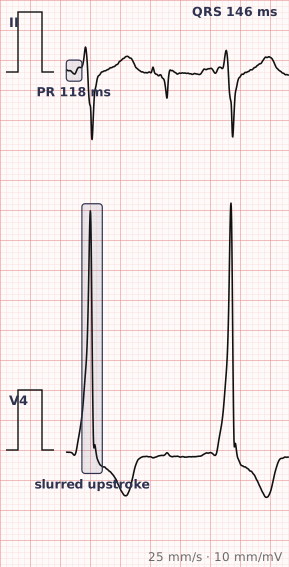
Wolff-Parkinson-White syndrome is pre-excitation of the ventricles through an accessory pathway that bypasses the AV node, producing a PR interval shorter than 120 milliseconds, a delta wave slurring the initial upstroke of the QRS, and a widened QRS complex.
ECG criteria
| Feature | What you see in WPW |
|---|---|
| PR interval | Under 120 ms. The accessory pathway conducts without the AV node's delay. |
| Delta wave | A slurred, gradual upstroke at the start of the QRS. This is the signature finding. |
| QRS | Widened, over 110 ms, but the widening is at the beginning — unlike bundle branch block, where it is at the end. |
| ST-T | Secondary repolarisation changes, often discordant to the delta wave direction. Frequently over-read as ischaemia. |
| P wave | Normal sinus P waves. |
| Rhythm | Sinus at baseline. WPW predisposes to AV re-entrant tachycardia and to pre-excited atrial fibrillation. |
How to spot it
- Measure the PR interval. Under 120 ms should immediately make you look for a delta wave.
- Look at the very start of the QRS across several leads. A delta wave is a slow, blurred takeoff rather than a sharp deflection.
- Confirm the QRS is wide because of that slurred beginning, not because of a late R' or a broad terminal S.
- Note the secondary ST-T changes so you do not report them as ischaemia.
- Look for pseudo-Q waves — a negative delta wave mimics pathological Q waves and leads to a false diagnosis of old infarction.
- Check whether the rhythm is sinus. Pre-excitation matters most when it is combined with atrial fibrillation.
What it gets confused with
| Looks like | How to tell them apart |
|---|---|
| Bundle branch block | Widening is terminal, with a normal PR interval and a sharp initial QRS deflection. |
| Old myocardial infarction | A negative delta wave mimics pathological Q waves. Check the PR interval before calling an old infarct. |
| Short PR without pre-excitation | Short PR but a normal sharp QRS with no delta wave. |
| Ventricular rhythm or ectopy | No preceding P wave. WPW complexes follow a normal P. |
| Pre-excited atrial fibrillation | Irregular, very fast, and with varying QRS widths. A dangerous presentation of the same pathway. |
Traps
- Atrial fibrillation in a patient with WPW is a medical emergency. The accessory pathway has no rate-limiting properties, so it can conduct extremely rapidly and the rhythm can degenerate into ventricular fibrillation. It appears as an irregular, fast, wide tachycardia with varying QRS width.
- AV nodal blocking drugs are contraindicated in pre-excited AF. Blocking the AV node pushes conduction preferentially down the accessory pathway and accelerates the ventricular rate.
- Negative delta waves are routinely misread as pathological Q waves, producing a false diagnosis of previous infarction. Always check the PR interval before reporting old infarction.
- Pre-excitation can be intermittent, so an earlier normal ECG does not exclude it.
- WPW pattern on the ECG without arrhythmia is a pattern; with documented tachyarrhythmia it becomes a syndrome. The distinction matters for how it is managed.
Why it happens
An accessory pathway of conducting myocardium — the bundle of Kent — connects atrium directly to ventricle, bypassing the AV node. Because it lacks the node's decremental delay, part of the ventricle is depolarised earlier than it would otherwise be. That early activation spreads slowly through muscle, producing the delta wave, while the remainder of the ventricle is activated normally through the AV node. The QRS is therefore a fusion of two wavefronts, which is why it is both early and wide.
Why it matters
WPW matters because of what it enables rather than what it looks like. The accessory pathway can support a re-entrant tachycardia, and — far more dangerously — can conduct atrial fibrillation to the ventricles at rates the AV node would never permit. It is one of the few ECG patterns where recognising it changes emergency drug choices immediately, and it is curable by ablation.
Questions
What is a delta wave?
A slurred, gradual upstroke at the beginning of the QRS complex, caused by early depolarisation of part of the ventricle through an accessory pathway. It is the defining ECG feature of ventricular pre-excitation.
Why is atrial fibrillation dangerous in WPW?
The accessory pathway lacks the rate-limiting delay of the AV node, so it can conduct the very rapid atrial impulses of fibrillation directly to the ventricles. Ventricular rates can become extremely high and the rhythm can degenerate into ventricular fibrillation.
Which drugs should be avoided in pre-excited atrial fibrillation?
Drugs that block the AV node — including adenosine, verapamil, diltiazem, beta blockers and digoxin — because blocking the node diverts conduction down the accessory pathway and accelerates the ventricular response.
What is the difference between WPW pattern and WPW syndrome?
The pattern is the ECG appearance alone: short PR, delta wave and wide QRS. It becomes a syndrome when the patient also has documented tachyarrhythmias attributable to the accessory pathway.
Reading about wpw syndrome is not the same as calling it on a tracing you have never seen.
Practise on real cases in ECG Pro