Short PR Interval on the ECG
A short PR interval is atrioventricular conduction occupying less than 120 milliseconds from the onset of the P wave to the onset of the QRS complex, which may occur with or without ventricular pre-excitation.
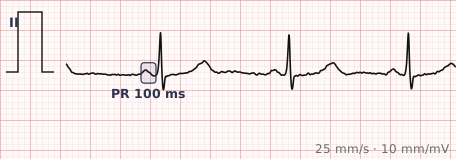
ECG criteria
| Feature | What you see in Short PR Interval |
|---|---|
| PR interval | Under 120 ms — less than three small squares. |
| Delta wave | The critical question. Present means pre-excitation (WPW); absent means a short PR without pre-excitation. |
| QRS | Widened if there is a delta wave; entirely normal if not. |
| P wave | Normal sinus P waves, if the rhythm is sinus. |
| ST-T | Secondary changes when pre-excitation is present; normal otherwise. |
| Rhythm | Usually sinus. A junctional rhythm with retrograde P waves can produce an apparently short PR. |
How to spot it
- Measure the PR interval carefully in a lead with a clear P wave onset — lead II is usually best.
- Confirm it is genuinely under 120 ms rather than merely at the short end of normal.
- Then look immediately at the start of the QRS for a delta wave. That single check determines what the finding means.
- If a delta wave is present, this is pre-excitation and should be reported as WPW pattern.
- If the QRS is entirely normal, this is a short PR without pre-excitation, which is far less significant.
- Check the P wave axis. An inverted P in lead II suggests a junctional or low atrial rhythm rather than true short AV conduction.
What it gets confused with
| Looks like | How to tell them apart |
|---|---|
| WPW syndrome | Short PR with a delta wave and a widened QRS. The important one to identify. |
| Junctional rhythm | P waves inverted, absent or after the QRS. The PR is short because the P is not sinus. |
| Low atrial rhythm | Inverted P wave in lead II with a short PR — the focus is close to the AV node. |
| Normal variant | PR at the lower end of normal in a young person with high sympathetic tone, with a completely normal QRS. |
Traps
- A short PR interval is only a headline; the delta wave is the story. Always inspect the QRS upstroke before deciding what the finding means.
- Check the P wave axis. If the P is inverted in lead II, the impulse is not coming from the sinus node and the "short PR" reflects a low atrial or junctional origin rather than fast AV conduction.
- A short PR with a normal QRS and no arrhythmia is generally benign and does not require investigation.
- Pre-excitation can be intermittent, so a normal PR on one tracing does not exclude an accessory pathway.
- Measure from the earliest onset of the P wave, which may be visible in one lead before another. Measuring in the wrong lead falsely shortens or lengthens the interval.
Why it happens
A short PR arises either because conduction bypasses the AV node through an accessory pathway, removing the physiological delay, or because the impulse originates low in the atrium or in the junction and therefore has less distance to travel. Enhanced AV nodal conduction can also shorten it without any accessory pathway being present.
Why it matters
The significance of a short PR depends entirely on whether pre-excitation accompanies it. With a delta wave it identifies an accessory pathway, which carries a risk of re-entrant tachycardia and, more seriously, of rapidly conducted atrial fibrillation. Without a delta wave and without arrhythmia, a short PR is usually of no consequence.
Questions
What is a short PR interval?
A PR interval of less than 120 milliseconds, measured from the onset of the P wave to the onset of the QRS complex — less than three small squares on standard paper.
Is a short PR interval dangerous?
It depends entirely on whether there is a delta wave. A short PR with a delta wave indicates ventricular pre-excitation and an accessory pathway, which can support dangerous arrhythmias. A short PR with a normal QRS is usually benign.
What should I check first when I see a short PR?
The initial upstroke of the QRS complex. A slurred takeoff is a delta wave and means pre-excitation. A sharp normal upstroke means the short PR is not due to an accessory pathway.
Reading about short pr interval is not the same as calling it on a tracing you have never seen.
Practise on real cases in ECG Pro