Reading an Apple Watch ECG
An Apple Watch ECG is a single-lead recording approximating lead I, captured over about 30 seconds between the wrist and the opposite hand, which can characterise rate and rhythm but cannot localise ischaemia or assess most of the ventricle.
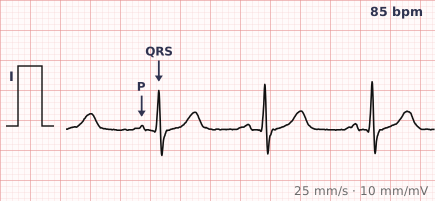
ECG criteria
| Feature | What a single lead gives you |
|---|---|
| Lead | One lead, approximating lead I — left arm to right arm. A 12-lead has twelve views; this has one. |
| Duration | About 30 seconds, so paroxysmal events are captured only if they happen during the recording. |
| Rate and rhythm | Assessable. Regularity, P waves, and R-R variability all read normally. |
| Intervals | PR and QRS duration are measurable. QT is measurable but harder without multiple leads. |
| Axis | Not assessable. Axis needs at least two limb leads. |
| Ischaemia | Not assessable. ST changes cannot be localised, and most territories are simply not viewed. |
How to spot it
- Establish what question the recording can answer. Rate and rhythm — yes. Territory, axis, chamber size — no.
- Check the baseline quality first. Motion, tremor and poor skin contact produce artefact that mimics both ectopy and fibrillation.
- Read rate and regularity exactly as you would on a rhythm strip.
- Look for P waves. Their presence, absence and relationship to the QRS carry the same meaning here as anywhere.
- Measure PR and QRS duration if the trace is clean enough.
- Stop before ST segments. A single lead cannot localise injury, and ST changes on one lead should not be reported as ischaemia.
- If the recording raises a genuine question, the answer is a 12-lead, not a longer look at this one.
What it gets confused with
| Looks like | How to tell them apart |
|---|---|
| Artefact | Irregular, non-physiological deflections with underlying regular QRS complexes marching through. Very common on wrist recordings. |
| Atrial fibrillation | Irregularly irregular with no P waves — the one thing single-lead recordings do well. |
| Premature beats | Early complexes, wide or narrow, visible on a single lead but not classifiable by territory. |
| Sinus arrhythmia | Gradual respiratory variation with normal P waves. Frequently misread by users as an abnormal rhythm. |
| Reversed orientation | Wearing the watch on the other wrist inverts the trace, mimicking abnormal complexes. |
Traps
- A single lead cannot exclude ischaemia, infarction, hypertrophy or axis deviation. Its normality is reassuring only about the narrow question it can answer.
- A 30-second recording only captures what is happening in those 30 seconds. A normal trace does not exclude a paroxysmal arrhythmia.
- Artefact from movement or tremor is the most common abnormality on wrist recordings and is regularly mistaken for ectopy or fibrillation.
- Automated interpretations are classifications, not diagnoses, and are explicitly limited to a small set of rhythm categories.
- When a patient brings a watch recording that raises a real question, the correct response is a 12-lead ECG — the single lead has already told you everything it can.
Why it happens
Placing a finger of the opposite hand on the crown completes a circuit from left arm to right arm through the chest, which is the same vector as lead I of a standard ECG. Because that is a single axis of view, the recording captures the component of cardiac electrical activity aligned with it and nothing about the components perpendicular to it — which is precisely the information a 12-lead adds.
Why it matters
Single-lead wearable recordings are increasingly brought to clinicians by patients, and they are genuinely useful for one thing: capturing a rhythm at the moment a symptom occurs, which a clinic ECG rarely manages. Knowing the boundary is what makes them useful — the recording answers a rhythm question well and answers almost nothing else, so treating a normal trace as a normal ECG is the error to avoid.
Questions
Can an Apple Watch ECG detect a heart attack?
No. Diagnosing myocardial infarction depends on the pattern of ST changes across multiple leads facing different territories, and a single-lead recording provides only one view. A 12-lead ECG is required.
What can a single-lead ECG reliably show?
Heart rate, rhythm regularity, the presence and relationship of P waves, premature beats, and PR and QRS duration when the trace is clean. That is enough to characterise many arrhythmias, and atrial fibrillation in particular.
Which lead does an Apple Watch ECG correspond to?
Approximately lead I, since the circuit runs from the wrist wearing the watch to the finger of the opposite hand — left arm to right arm, the same vector as lead I on a standard 12-lead ECG.
Why do wearable ECGs show so much artefact?
The electrodes are small, dry and on moving limbs, so muscle activity, tremor and poor skin contact all introduce noise. Artefact is the most common abnormality on these recordings and is frequently mistaken for ectopic beats or fibrillation.
A single lead answers a narrow question well. A 12-lead answers the rest.
Practise on real cases in ECG Pro